
Jumia Kenya is the largest e-commerce marketplace in the country — and it is open to anyone who wants to sell. Whether you have a small home business, a shop in Gikomba, a factory in Thika, or products you make by hand, Jumia gives you access to millions of buyers across Kenya without needing a physical storefront or a huge marketing budget.
But knowing how to sell on Jumia Kenya the right way — from registration, to listing products, to getting paid — makes the difference between a seller who struggles and one who builds a consistent online income.
This guide covers everything a beginner needs to know about online selling in Kenya through Jumia: how to register as a seller, how to list products correctly, how Jumia’s fees work, how to get paid via M-Pesa or bank transfer, and the practical strategies that help new sellers make their first sales fast.
If you have been thinking about starting an ecommerce business in Kenya, this is the most practical starting point available to you right now.
To sell on Jumia Kenya, register at seller.jumia.co.ke, submit your ID and business documents, list your products with clear photos and descriptions, and fulfil orders through Jumia’s logistics network (J-Force or drop-off points). Jumia pays sellers every two weeks via M-Pesa or bank transfer after deducting a commission of 3–15% depending on the product category. You can start selling as an individual — no registered business is required to begin.
Why Sell on Jumia Kenya?
Before diving into the steps, it helps to understand why Jumia is worth your time as a Kenyan seller:
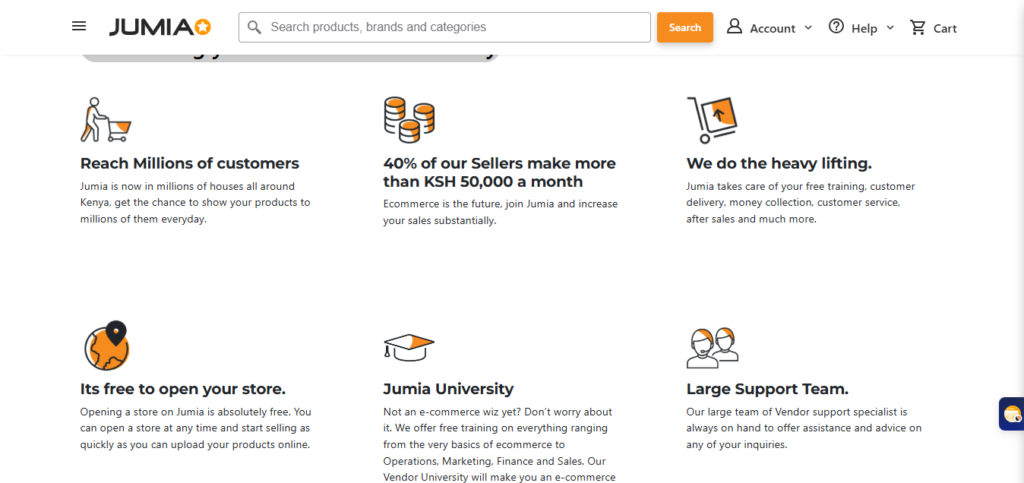
- Massive reach: Jumia Kenya attracts millions of monthly visitors — far more than most individual sellers could reach independently
- Built-in trust: Buyers already trust the Jumia platform, which reduces the hesitation that kills sales on WhatsApp or social media
- Logistics handled: Jumia manages delivery through its own network, so you do not need to run around Nairobi dropping off packages
- No website needed: You get a fully functioning online store without building or paying for a website
- Mobile-first payments: Payouts via M-Pesa make it practical for sellers across Kenya — not just those with bank accounts
Who Can Sell on Jumia Kenya?
Jumia Kenya accepts sellers across three categories:
- Individual sellers — Anyone with a national ID can register and start selling personal or resale items
- Small businesses — Sole proprietors with a business certificate can register under a business name
- Companies and manufacturers — Registered businesses with a KRA PIN certificate and business registration documents
You do not need to be a registered company to start. A national ID, phone number, and valid M-Pesa or bank account are enough to get going.
Step-by-Step: How to Register as a Jumia Seller in Kenya
Step 1: Visit the Jumia Seller Centre
Go to seller.jumia.co.ke and click “Become a Seller”. This takes you to the registration portal called the Jumia Seller Centre — this is your dashboard for managing everything.
Step 2: Fill in Your Personal or Business Details
You will be asked to provide:
- Full name (as on your national ID)
- Email address and phone number
- Business name (can be your personal name if you are an individual seller)
- Physical address and county
Step 3: Submit Verification Documents
Jumia requires identity verification before activating your account. Prepare the following:
For individual sellers:
- Copy of your National ID (front and back)
- M-Pesa registered phone number or bank account details
For business sellers:
- National ID of the business owner
- Certificate of Business Registration or Certificate of Incorporation
- KRA PIN certificate
- Bank account details or M-Pesa Till/Paybill number
Step 4: Sign the Seller Agreement
Read and accept Jumia’s seller terms and conditions. This is a standard digital agreement outlining commission rates, return policies, and seller responsibilities.
Step 5: Wait for Account Approval
Jumia typically approves new seller accounts within 2–5 business days. You will receive an email and SMS notification once your account is active. If you do not hear back within 5 days, follow up via the Jumia Seller Support email or WhatsApp line.
Step 6: Access Your Seller Dashboard
Once approved, log in to the Seller Centre at seller.jumia.co.ke. This is where you will list products, track orders, manage inventory, and view your payment reports.
Read also: How to Make Money with M-Pesa in Kenya
How to List Your First Product on Jumia Kenya
Your product listing is your storefront. A well-crafted listing gets found in search, builds buyer confidence, and converts browsers into buyers. Here is how to do it right.
Step 1: Go to “Add a New Product”
In your Seller Centre dashboard, navigate to Products → Add Product.
Step 2: Choose the Right Category
Selecting the correct category is critical — it determines who sees your product and which commission rate applies. Take time to browse Jumia’s category tree and place your product in the most specific, accurate category available.
Step 3: Write a Strong Product Title
Your title is the most important SEO element of your listing. Follow this formula:
[Brand] + [Product Name] + [Key Specification] + [Variant]
Examples:
- Samsung Galaxy A15 Smartphone — 128GB, 6GB RAM, Black
- Organic Kenyan Honey — 500g Raw Wildflower, Unprocessed
- Men’s Leather Office Shoes — Brown, Size 42, Formal
Avoid vague titles like “Nice Shoes” or “Good Phone.” Specific titles rank higher in Jumia search results and attract more qualified buyers.
Step 4: Upload High-Quality Product Photos
Photos are the single biggest factor in whether a buyer clicks on your listing or scrolls past. Jumia recommends:
- Minimum 3 photos per product (front, back, and detail shots)
- White or plain background for the main image
- Minimum resolution: 500 x 500 pixels (higher is better)
- No watermarks, text overlays, or borders on the main image
- Show the product from multiple angles and in real-life use where possible
If you do not have a studio setup, a white bedsheet, natural daylight, and a clean smartphone camera produce excellent results.
Step 5: Write a Detailed Product Description
Your description should answer every question a buyer might have before purchasing:
- What is the product and what does it do?
- What are the exact dimensions, weight, or specifications?
- What is included in the package?
- Who is it for and when/how is it used?
- What makes it better than alternatives?
Use short paragraphs and bullet points for readability. Avoid copying descriptions from other sites — write original content.
Step 6: Set Your Price Competitively
Before pricing your product, search Jumia for similar items and note the price range. Your price needs to:
- Cover your product cost + Jumia commission + packaging + delivery (if applicable)
- Be competitive with similar listings
- Leave a reasonable profit margin
Tip: Use Jumia’s “Special Price” feature to create time-limited discounts. Products with discounts appear in promotional sections and get significantly more visibility.
Step 7: Set Stock Quantity and SKU
Enter how many units you have available. Keep this updated — overselling leads to cancellations, which hurts your seller rating.
Jumia Kenya Seller Fees and Commission Rates
Understanding Jumia’s fee structure is essential for pricing products profitably. Here is a breakdown:
| Fee Type | Details |
|---|---|
| Registration Fee | Free — no cost to sign up |
| Listing Fee | Free — no charge per product listed |
| Sales Commission | 3% – 15% depending on category |
| VAT on Commission | 16% VAT applied on top of commission |
| Fulfilment Fee | Charged if using Jumia Express (JExpress) warehousing |
| Return Handling Fee | Applies if a buyer returns a product |
Commission Rates by Category (Approximate)
| Product Category | Commission Rate |
|---|---|
| Phones & Tablets | 3% – 5% |
| Electronics & Appliances | 5% – 8% |
| Fashion & Clothing | 10% – 15% |
| Health & Beauty | 8% – 12% |
| Home & Living | 8% – 12% |
| Groceries & Food | 5% – 8% |
| Books & Stationery | 8% – 10% |
| Sporting Goods | 8% – 10% |
Always verify current commission rates in your Seller Centre dashboard, as Jumia updates these periodically.
How Order Fulfilment Works on Jumia Kenya
When a customer places an order for your product, here is what happens:
Option 1: Seller Fulfilled (Drop-Off)
- You receive an order notification via email and SMS
- You have 24–48 hours to confirm and prepare the item
- Package the item securely and label it with the Jumia order ID
- Drop it off at the nearest Jumia drop-off point or pick-up station
- Jumia handles delivery to the customer from there
Option 2: Jumia Express (JExpress) — Recommended for Volume Sellers
- Send your inventory to Jumia’s warehouse in advance
- Jumia picks, packs, and ships orders on your behalf
- Products get the “Jumia Express” badge — which significantly boosts conversion rates
- Best for sellers with fast-moving products and consistent stock levels
Drop-off locations in Kenya include: Nairobi (Industrial Area HQ, Westlands, Mombasa Road), Mombasa, Kisumu, Nakuru, Eldoret, and other major towns. Check seller.jumia.co.ke for the full current list.
How Jumia Pays Sellers in Kenya
Jumia pays sellers on a bi-weekly (fortnightly) cycle. Here is how the payment process works:
- Customer places an order and Jumia confirms delivery
- A 7-day return window applies after delivery
- Once the return window closes without a return, the sale is cleared for payment
- Jumia processes payment in the next payment cycle
- Funds are sent to your registered M-Pesa number or bank account
Payment methods supported:
- M-Pesa (most popular and fastest for individual sellers)
- Kenyan bank account (Equity, KCB, Co-op, NCBA, Stanbic, etc.)
Typical payment timeline: Orders delivered and cleared → 7-day return window → next fortnightly cycle → funds in your M-Pesa or bank within 14–21 days of the sale.
What to Sell on Jumia Kenya: Best Product Categories for New Sellers
Choosing the right product is as important as how you list it. These categories consistently perform well for new sellers on Jumia Kenya:
- Phone accessories — Screen protectors, cases, chargers, and cables. Low cost, high demand, fast turnover.
- Fashion and clothing — Especially women’s fashion, children’s wear, and shoes. High margins but higher return rates.
- Health and beauty — Skincare, hair products, and supplements. Strong repeat purchase behaviour.
- Home and kitchen items — Cooking utensils, storage, and décor. Growing demand as more Kenyans shop online for home goods.
- Baby products — Diapers, feeding accessories, and clothing. High-trust category with loyal repeat buyers.
- Electronics accessories — Earphones, power banks, USB hubs. Lightweight, easy to ship, good margins.
- Locally made products — Kenyan handmade crafts, organic foods, and natural beauty products stand out in a market dominated by imports.
Common Mistakes to Avoid as a New Jumia Seller
New sellers on Jumia Kenya frequently make these costly errors:
- Poor product photos — Blurry, dark, or cluttered photos are the number one reason listings get ignored. Invest in good photos before launching.
- Incorrect category selection — Listing a phone case under “Electronics” instead of “Phone Accessories” means fewer buyers find it and potentially higher commissions.
- Ignoring the return policy — Returns are part of e-commerce. Failing to understand Jumia’s return policy leads to disputes that hurt your seller rating.
- Pricing without accounting for commission — Many new sellers forget to factor in Jumia’s 3–15% commission plus 16% VAT on the commission, resulting in sales that barely break even or make a loss.
- Slow order processing — Confirming orders after the 48-hour window results in automatic cancellations and seller penalties. Set phone notifications for every order.
- Listing out-of-stock products — Cancelled orders due to stock issues damage your seller score significantly. Keep your inventory count accurate at all times.
- Skipping customer service — Responding to buyer questions and reviews builds trust and improves your seller rating, which directly affects how Jumia ranks your listings.
Tips to Succeed Faster as a Jumia Seller in Kenya
- Start with 5–10 well-listed products rather than rushing to upload 100 poorly listed ones. Quality listings outperform quantity every time.
- Use Jumia’s promotional tools — Flash sales, Jumia Black Friday, and the Jumia Anniversary campaign drive massive traffic spikes. Plan your stock and pricing around these events.
- Aim for the “Jumia Verified” badge — Verified sellers get more visibility and buyer trust. Maintain high ratings, fast fulfilment, and low cancellation rates.
- Source locally to stay competitive — Suppliers in Gikomba, Eastleigh, Ngong Road, and Industrial Area often offer better prices and faster restocking than importing.
- Monitor your competitors weekly — Check how similar products are priced and how their listings are structured. Adjust yours to stay competitive.
- Build your seller rating early — Your first 20–30 sales set the tone for your account’s long-term performance. Prioritise speed, accuracy, and good packaging in the early days.
- Sell on multiple platforms simultaneously — List on both Jumia and Kilimall, and promote on Instagram or TikTok to drive additional traffic to your Jumia store.
Frequently Asked Questions: Selling on Jumia Kenya
Is it free to sell on Jumia Kenya?
Yes — registering as a seller and listing products on Jumia Kenya is completely free. Jumia only earns money when you make a sale, by deducting a commission (3–15% depending on category) plus 16% VAT on that commission from your payout.
How long does Jumia Kenya take to approve a seller account?
Jumia typically approves new seller accounts within 2–5 business days after you submit complete and accurate documents. Incomplete submissions are the most common reason for delays. Ensure your ID, business documents, and payment details are all correct before submitting.
Can I sell on Jumia Kenya without a registered business?
Yes. Individual sellers can register using a national ID and personal M-Pesa number. You do not need a business registration certificate to start. However, registering as a business gives you access to higher selling limits and additional features.
How does Jumia handle returns and refunds?
Jumia has a 7-day return policy for most product categories. If a buyer returns a product, Jumia investigates the claim. If the return is valid (wrong item, defective product), the seller bears the return cost and the sale is reversed. Maintaining accurate listings and good packaging significantly reduces return rates.
What is the best product to sell on Jumia Kenya as a beginner?
Phone accessories (cases, screen protectors, chargers) are widely recommended for beginners. They are lightweight, inexpensive to source, have consistent demand, attract low commission rates (3–5%), and are easy to package and ship. They also have low return rates compared to fashion or electronics.
Conclusion: Start Selling on Jumia Kenya Today
Understanding how to sell on Jumia Kenya is the first step to building a real, scalable ecommerce business in Kenya — one that earns money every day without requiring a physical shop or a huge upfront investment.
The platform is accessible, the process is straightforward, and the market is growing. Millions of Kenyan shoppers are already on Jumia looking for products exactly like yours. The sellers who win are not necessarily the ones with the biggest budgets — they are the ones who list better, fulfil faster, and treat their Jumia store like a real business.
Register your seller account this week. List your first five products with great photos and accurate descriptions. Process your first orders within 24 hours. Build your rating with consistency and good service. That is the foundation of every successful Jumia seller story in Kenya.
🚀 Action Step: Visit seller.jumia.co.ke today and complete your registration. Have your National ID, KRA PIN, and M-Pesa number ready. Your first product could be live on Jumia Kenya within 48 hours — and your first sale could follow shortly after.
Read also;
- How to Make Money with M-Pesa in Kenya
- Affiliate Marketing in Kenya
- How to Make Money on TikTok in Kenya
- How to Start Blogging in Kenya